

 English
 US

News
Feb 13, 2026
Royal Birkdale Renovation
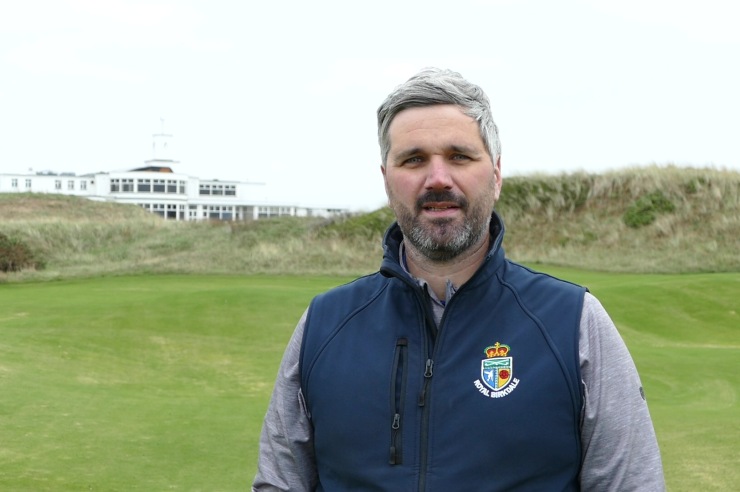
We caught up with Sean McLean, Course Manager at Royal Birkdale Golf Club. This was their maintenance week, and the course was partially closed to...
Published 28th August 2026 News
Greensmower-mounted vibratory spiker seeders produce the least visible surface disturbance of the four main overseeding methods, and greens usually stay fully playable.
For fine bent and fescue, low disturbance and good establishment are no longer a trade-off; precision placement delivers both.
Precision metering cuts seed spend by around 70%. Overseeding 10,000 m² of greens three times a year costs in bent seed at 1.4 g/m², against at a conventional 5 g/m² rate.
Bent seed needs soil temperatures around 10-15°C to germinate reliably and takes 10-14 days to come through.
If your greens are steadily filling with Poa annua, the problem is rarely a lack of intent. You know you need more bent or fine fescue in the sward. What holds the programme back is the cost of the seed, and the opportunity to do the work at the optimum time, between golf fixtures
GreenTek has been involved with greens maintenance equipment for UK golf courses since 1969, and overseeding is one area where the machine changes what is practical in season.
This article compares the four methods Course Managers choose between, explains which causes least surface disturbance, and shows what a season of overseeding costs.
A note on scope: this article compares method types rather than individual manufacturers, and uses GreenTek equipment as the worked example where specific figures are needed. Comparable machines are available from other suppliers.
Disruption on golf greens is not necessarily about closing the green; it is about whether members notice a change in trueness or appearance. Many UK courses overseed with the green still in play, so the practical question is how visible the work is and how quickly the putting surface plays normally again.
That comes down to how much soil the machine opens, how long those openings stay visible, and whether the surface needs rolling or topdressing afterwards. In hot, dry spells any opening stays visible longer as the rootzone dries around it.
Four overseeding technologies are in common use on UK golf greens: vibratory spiker seeders, dimple seeders, disc seeders and air assisted seeders. They differ in how they open the surface and how deep they place seed, which decides whether a method suits in-season work or a renovation window.
|
Method |
Typical power unit |
Best suited to |
Surface disturbance |
Best used for |
|
Vibratory spiker seeder |
Triplex greensmower |
Bent and fine fescue |
Very low |
Frequent in-season overseeding |
|
Dimple seeder |
Compact tractor |
Bent |
Low |
Bent establishment where a tractor is an acceptable power unit |
|
Disc seeder |
Compact tractor |
Fescue and ryegrass |
Moderate |
Spring and autumn renovation, fairways |
|
Air injection seeder |
Compact tractor |
General overseeding |
Low to moderate |
Accurate overseeding where a large tractor mounted machine is acceptable |
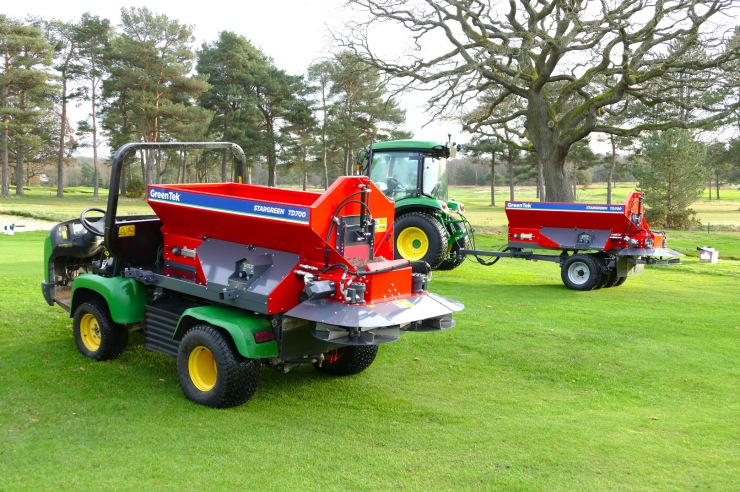
For routine golf greens overseeding, a greensmower-mounted vibratory spiker seeder produces minimal visible surface disturbance. The vibrating spikes create thousands of small, clean holes and meter seed directly into them. Followed by light rolling, greens normally stay fully playable.
At Scarcroft Golf Club near Leeds, Head Greenkeeper Matt Houseman overseeds two to three times a year using GreenTek Dyna-Seeder units. He reports uptake rising from around 30% under his previous method to between 70% and 75% over an eight-year programme. These are the club's own figures rather than trial data.
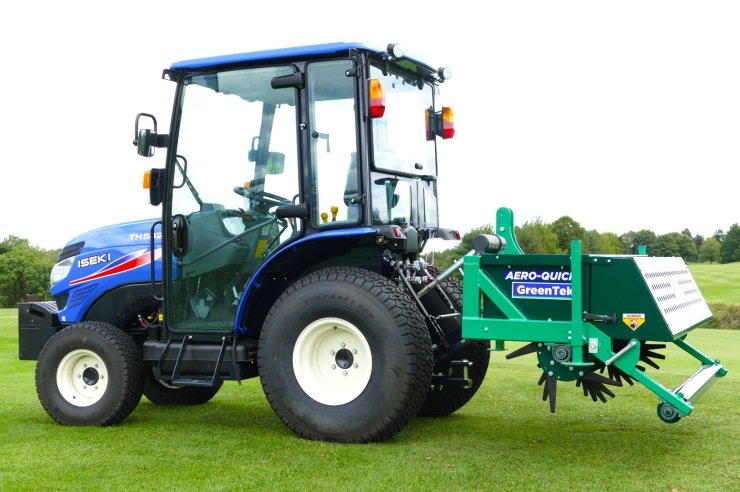
Dimple seeders also cause relatively little disruption but tend to leave more visible indentations than fine vibratory spiking. Disc seeders cut narrow slits that place seed accurately, but the slits are more noticeable and can open as the surface dries. Air assisted seeders dispense the seed using air flow, but remain less common on UK greens due to their initial cost.
Germination depends on getting seed into direct contact with soil, and the methods differ in how reliably they manage that across seed sizes. Bent seed germinates best at a depth of 3-5mm, fescue at 6-8mm, and dwarf/ryegrass at 10-15mm. These depths are into the actual rootzone, beneath the thatch layer.
|
Seed type |
Most suitable methods |
|
Bent |
Vibratory spiker or dimple seeder |
|
Fine fescue |
Vibratory spiker or disc seeder |
|
Dwarf perennial ryegrass |
Disc seeder |
This is where the trade-off between minimising disruption and maximising germination actually sits. For bent and fine fescue, precision placement gives you both, so in-season work is practical. For larger seed, better establishment means accepting more disturbance, which is why that work waits for a renovation window.
Surface disturbance is hard to judge from a specification sheet, so arrange a demonstration on your own greens.
On greens, the recurring cost of overseeding is seed rather than machinery, and application rate controls it. Pure bent seed sells for roughly £20–£22 per kilogram depending on quantity.
A precision seeder uses less seed because it meters and places the seed more accurately. Seed metered into open holes is protected from wind drift, mowing and birds, while broadcast seed on a dense sward largely never reaches soil. A lower rate therefore does not mean a thinner result; the Scarcroft figures above show uptake more than doubling while seed use fell.
Conventional overseeding of pure bent is specified at around 5 g/m². The Dyna-Seeder Mk2 places pure bent as low as 1.4 g/m² using the optional pure bent shaft.
Seed required (kg) = total green area (m²) × application rate (g/m²) ÷ 1,000
On 10,000 m² of greens, at £21 per kilogram:
|
Application rate |
Seed per pass |
|
5 g/m² (conventional) |
50 kg |
|
1.4 g/m² (precision metered) |
14 kg |
This shows a recurring saving that is usually easier to put to a committee than a capital case. Figures are estimates; substitute your own green area and seed price.
Timing decides whether seed germinates at all; the machine decides how much of it reaches soil. Bent needs soil temperatures around 10-15°C to germinate reliably, in the UK, usually May to late September, and takes around 10-14 days to come through.
Good practice is therefore of highest importance:
Overseed while soil temperatures still support active growth.
Apply seed into a dry surface with moisture beneath it.
Topdress lightly where the surface needs it.
Roll afterwards to restore surface smoothness.
Maintain normal irrigation and nutrition to support establishment.
For many courses this points towards light, frequent overseeding whenever conditions allow.
With low-disturbance systems, greens usually stay fully playable and the work is difficult to spot. Machines fitted to a triplex mower look like routine mowing from a distance.
Light rolling restores surface trueness and improves seed-to-soil contact without damaging correctly placed seed.
Whenever soil temperatures support active growth and there is enough moisture in the rootzone. In the UK that is typically May to late September for bent.
Regular, accurate overseeding with bent seed alongside an appropriate cultural management programme generally works better than one annual renovation.
Improving sward composition without upsetting members used to mean choosing between results and playability. For bent and fine fescue, precision placement has removed that choice. For larger seed it still applies, and the work belongs in a renovation window.
Confirm which species you are introducing and its seed size.
Check which power units are available in season.
Decide whether your programme is little-and-often or renovation-led.
Work out your seed cost per pass using the table above.
Arrange a demonstration on your own greens.
About GreenTek: GreenTek has been involved with turf maintenance equipment in the UK since 1969 and is now in its third generation of family ownership. Based near Leeds, GreenTek supplies greenkeepers and grounds managers through a UK dealer network.
Pricing disclaimer: Prices are indicative and correct at the time of publishing. Seed prices vary by supplier, variety and quantity.

All products come with a 5 Year Warranty, so you don’t have to worry about breakdowns and repairs.

We guarantee our equipment will do exactly what we claim, or we'll uplift it and refund you 100% in full, right up to 12 months after purchase!

All products with this logo have been built in Britain.

 Request a Hat/Cap