

 English
 US


News
Feb 13, 2026
Royal Birkdale Renovation
We caught up with Sean McLean, Course Manager at Royal Birkdale Golf Club. This was their maintenance week, and the course was partially closed to...
Published 25th September 2026 News
The broad term “slitting” encompasses a range of different processes on a golf course. A tractor-mounted machine making deep slits, a triplex carrying shallow slicing blades and a set of Star-Slitter cassettes all open the turf, but they work at different depths and serve different purposes.
Choosing correctly starts with the problem beneath your feet. Is the aim to treat a deeper restrictive layer, prune lateral growth, or keep the immediate surface open between more substantial aeration operations?
A tractor-mounted slitter fitted with suitable fine-turf tines can open channels farther into the profile than a shallow surface treatment. This can assist air and water movement where ground conditions allow the blades to penetrate cleanly.
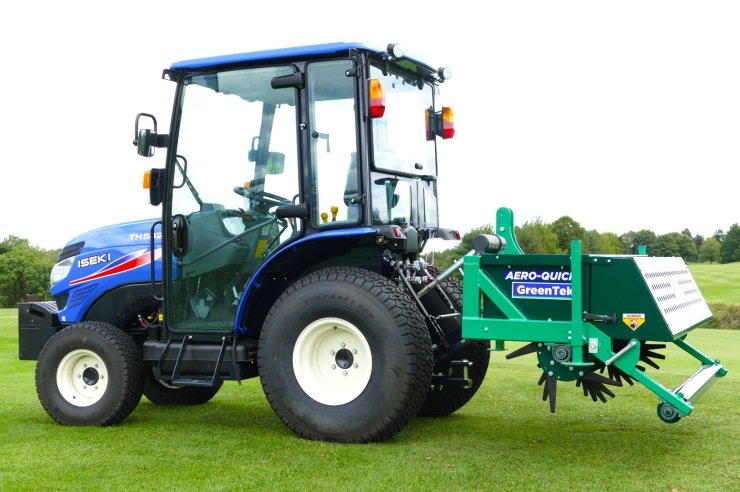
The Aero-Quick accepts different attachments, including fine-turf slitting tines. Its versatility makes it popular for many different sports turf areas from football pitches to golf greens, by selecting the appropriate tines for the job. For golf greens, choose the fine-turf slitting tines and use a suitable lightweight compact tractor to operate it.
Diamond pattern blades create a wider slit that also severs roots and lateral growth. That pruning effect can form part of sward management, provided the grass is healthy enough to recover.
Work when the ground permits a clean result. Hard, dry conditions can restrict penetration and lead to cracking; whilst overly wet conditions can leave wheel damage. But whenever conditions are suitable, slitting is a very beneficial reatment.
A second approach uses slicing blades in an aerator carried by a greens triplex. It gives a different combination of manoeuvrability and surface treatment, particularly where the intention is regular work within the upper profile.
GreenTek Dyna-Corer units have interchangeable tines, including hollow core, solid tine, cross tine and slicing blades for continuous or interrupted slits. Their individual heads follow the contours of the green. The blade option changes the operation from removing small cores to cutting narrow slits, so it enables you to specify which treatment you want.
Slicing can cut through lateral growth, severing lateral runners and stimulating denser turf. It does not extract the organic material that hollow tines remove. Choose between the two according to the maintenance objective.
For frequent shallow work, Thatch-Away Star-Slitter Cassettes provide another practical option. Mounted on a compatible greens triplex fitted with the Thatch-Away units, they penetrate to approximately 20mm with almost no surface disturbance.
Their role is to help puncture surface sealing and maintain entry points for air and water. Where the turf conditions are suitable, this can fit into a busy playing schedule with little interruption. It is particularly useful when a quick, manoeuvrable treatment is wanted across all greens.
There is a wide array of different aeration equipment available to the modern greenkeeper, all with its own purpose. By investing wisely, a golf club can build a range of complimentary machines that will last a long time, often decades, and help to keep the course in good health throughout increasingly long playing seasons.
For budgeting purposes, in 2026 you would expect to pay around £6,000 for the Aero-Quick, £9,000 for a set of Dyna-Corers, and £4,000 for a set of Thatch-Away Star-Slitter Cassettes.
Slitting cuts openings without extracting plugs. Hollow coring removes material, allowing it to be collected and, where specified, replaced with suitable dressing. Choose according to whether the aim is opening the surface or removing material.
These penetrate to approximately 20mm. They are intended for shallow aeration with little surface disturbance, rather than treatment of compaction below their reach.
Assess moisture and turf condition first. Hard ground may prevent clean penetration, and stressed turf may recover poorly from cutting. A trial pass should show clean openings without lifting or tearing; postpone work if it does not.
No. Cutting roots or lateral stems is an intervention whose result depends on the species, the most relevant being Creeping Bentgrass (Agrostis Stolonifera). It can support a planned sward-management programme, but avoid excessive cutting or working on stressed turf.
No, you need to select a deeper treatment for that. Locate the problem in a profile sample and choose an aeration method that reaches it. Shallow slitting can complement that work by maintaining surface openings.
Shallow Star-Slitter work is designed to leave the surface sufficiently undisturbed for play to continue. Deeper aeration methods will often require rolling afterwards to restore a true putting surface.

All products come with a 5 Year Warranty, so you don’t have to worry about breakdowns and repairs.

We guarantee our equipment will do exactly what we claim, or we'll uplift it and refund you 100% in full, right up to 12 months after purchase!

All products with this logo have been built in Britain.

 Request a Hat/Cap