

 English
 US


News
Feb 13, 2026
Royal Birkdale Renovation
We caught up with Sean McLean, Course Manager at Royal Birkdale Golf Club. This was their maintenance week, and the course was partially closed to...
Published 11th September 2026 News
Topdressing is a key task in sports turf management. Its value lies in what it does beneath the grass: helping manage organic matter, improving surface consistency and supporting a rootzone that performs more reliably through the season.
Getting those benefits depends on choosing suitable material and applying it evenly. The spreader needs to make that work practical within the staff time, machinery and maintenance windows available.
On golf greens, regular sand topdressing helps dilute accumulating organic matter and maintain smoother, firmer playing surfaces. On sports pitches, a suitable programme can help improve surface levels and the performance of the upper rootzone. It works alongside aeration and other maintenance, rather than replacing them.
The material must suit the existing construction and the intended improvement. Cheap sand is poor value if its particle sizes are unsuitable. Ask for an analysis and discuss compatibility with your agronomist or material supplier, particularly before changing an established programme. Using topdressing material that is incompatible with the existing rootzone can create distinct soil layers, restricting water movement and root development. In severe cases, these layers can contribute to waterlogging, anaerobic conditions and black layer formation.
Application rate matters too. A light dressing through the growing season serves a different purpose from filling aeration holes during renovation. Choose a spreader that can deliver the range of rates you actually need, then check its settings with the material you will use.
A drop spreader places material directly beneath the hopper. This can be useful where a confined spreading width is desirable, but covering large areas involves more passes.
Twin-spinner machines broadcast material across a wider swath, making them particularly useful where output matters. Adjustable delivery and spinner settings allow the operator to move between a light dusting and heavier applications, provided the machine is correctly set up.
The widest possible throw is not always the best working width. Assess the evenness of the pattern, the overlap needed and the boundaries of the area. A demonstration should show a consistent application across successive passes, rather than simply an impressive distance of throw.
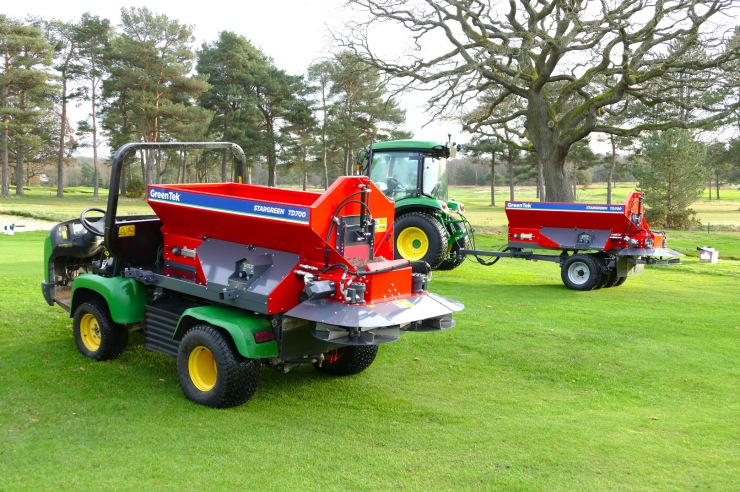
A demountable machine on a suitable turf truck gives a compact outfit for greens and tees. The StarGreen TD700DM has a 700-litre hopper, with an approximate sand capacity of 1.2 tonnes. Confirm the fully laden combination against the vehicle manufacturer's limits: hopper volume alone does not establish a safe load.
Trailed models suit sites using compact tractors and offer a choice of capacities. The StarGreen TD700T provides approximately 1.2 tonnes, the TD1500T approximately 2.5 tonnes and the TD3000T up to 5 tonnes. Material density and the machine's rated limits determine the actual load.
Consistent delivery to the discs is essential. The StarGreen topdressers use a cleated conveyor belt, and have adjustable belt and spinner speeds, plus an adjustable hydraulically operated flow gate. These features let the operator regulate the material feed and spreading pattern.
StarGreen topdresser cover a wide range of sizes and specifications, a vary accordingly from around £11,000 to £32,000 in 2026. Compare hopper capacity, mounting or chassis arrangements and the controls included in the quoted specification. On truck mounted spreaders, check whether demount legs are included within the standard price; they are on StarGreen spreaders.
Peer recommendation is very helpful when selecting machinery, and your local GreenTek dealer will likely be able to tell you of other owners in your area that you can speak to.
Suitable material can improve the performance of the upper rootzone over time, particularly when combined with aeration. It cannot correct every drainage problem: compacted layers, unsuitable construction or failed drains may need separate treatment.
No. Select sand for its physical characteristics and compatibility with the existing rootzone and maintenance programme. Obtain an analysis and professional advice before changing material. Price and appearance alone are unreliable guides.
Base the rate on the surface, growth, organic matter management and whether you are filling aeration holes. There is no single rate for greens, tees and sports pitches. Calibrate the spreader and check that the material can be incorporated effectively.
No. A suitable twin-spinner topdresser can provide light or heavier applications by adjusting the material feed, spinner settings, flow gate opening, and forward speed. Check the result with your chosen material rather than relying on a setting borrowed from another site.
No. Litres describe volume; tonnes describe mass. The weight of a hopperful changes with the material and its moisture content. Always observe the topdresser's rated load and the carrying or towing limits of the power unit.
Normally it needs to be worked into the sward or aeration holes rather than left covering the leaf. Match the brushing method to the turf and conditions, checking that the operation incorporates material without bruising the turf.

All products come with a 5 Year Warranty, so you don’t have to worry about breakdowns and repairs.

We guarantee our equipment will do exactly what we claim, or we'll uplift it and refund you 100% in full, right up to 12 months after purchase!

All products with this logo have been built in Britain.

 Request a Hat/Cap